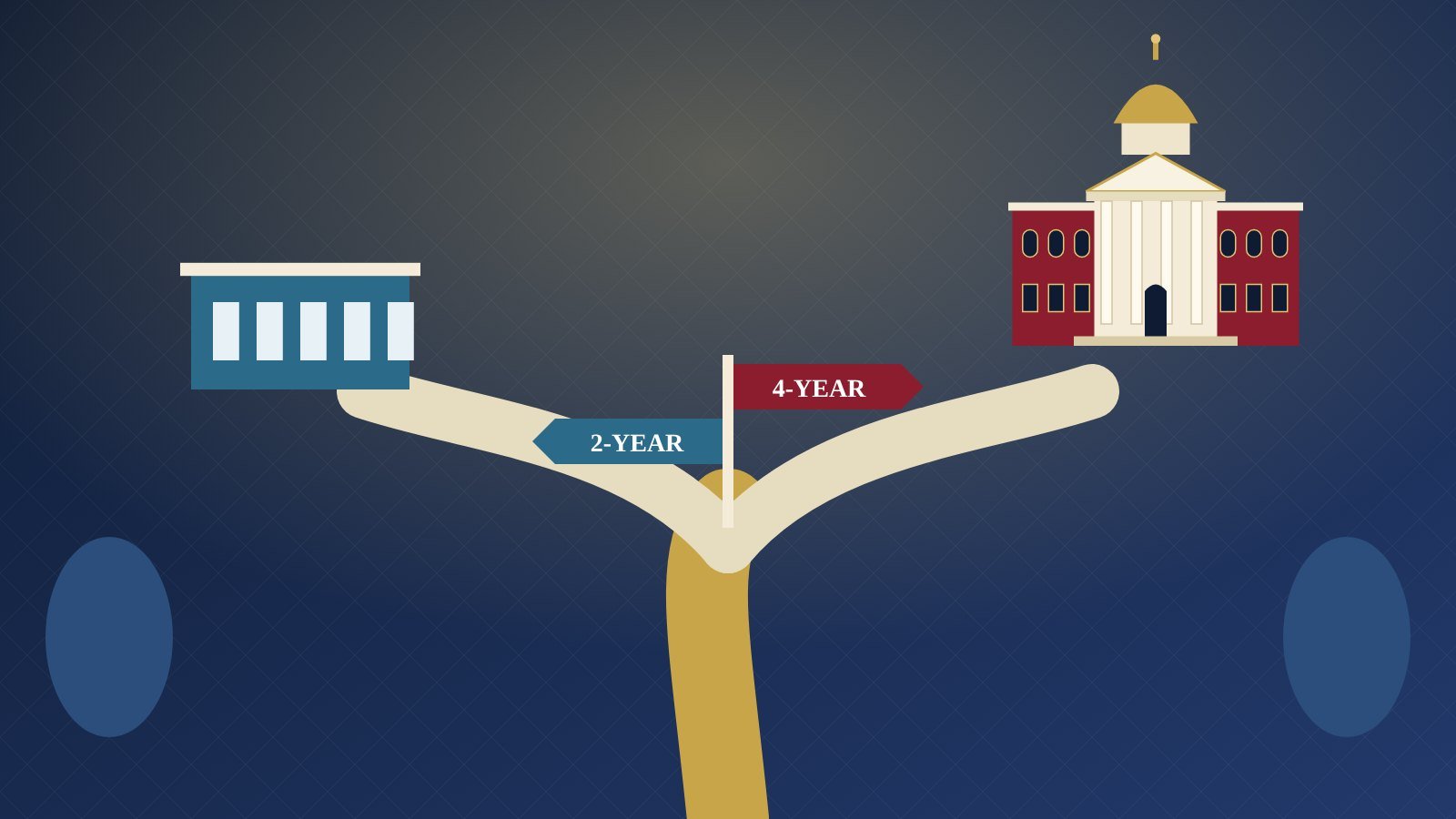
Every year, millions of American students face the same decision: start at a community college or go straight to a four-year university? There's no single right answer. Both paths can lead to a bachelor's degree and a rewarding career. The best choice depends on your finances, academic goals, readiness and personal circumstances. This guide compares the two honestly so you can decide with confidence.
What is a community college?
Community colleges are public, two-year institutions found in nearly every region of the country. They offer:
- Associate degrees (usually about 60 credits), including transfer-focused degrees designed to count toward a bachelor's.
- Certificates in career fields such as nursing assistance, welding, IT support, HVAC and early childhood education, some of which take a year or less.
- Open admission — most accept anyone with a high school diploma or equivalent, though some programs (like nursing) are competitive.
- Flexible schedules with evening, weekend and online classes for working students.
A four-year university, by contrast, offers bachelor's degrees (usually about 120 credits) and often graduate programs, along with a residential campus experience at many schools.
Cost: the biggest difference
The price gap is significant. According to the College Board, average published tuition and fees for 2025–26 were about $4,150 at public two-year colleges, compared with about $11,950 for in-state students at public four-year colleges and about $45,000 at private nonprofit four-year colleges.
Many community college students also live at home, which can save thousands more on housing and food. And for students with financial need, a federal Pell Grant (up to $7,395 for 2026–27) may cover all or most of community college tuition, sometimes with money left over for books and transportation. Many states also run “promise” or free community college programs for eligible residents — check your state's higher education website.
Example: A student who completes two years at a community college and then transfers to an in-state public university could save a substantial amount on tuition alone compared with four years at the university — before even counting housing savings.
Side-by-side comparison
| Factor | Community college | Four-year university |
|---|---|---|
| Average tuition | Much lower | Higher, especially at private schools |
| Admission | Usually open admission | Ranges from open to highly selective |
| Class size | Typically small | Varies; large lectures common at big universities |
| Who teaches | Faculty focused on teaching | Professors, plus graduate assistants at some schools |
| Campus life | Mostly commuter; fewer residential activities | Residence halls, clubs, athletics, traditions |
| Research opportunities | Limited | More available, especially at research universities |
| Flexibility | High: part-time, evening, online | Often designed for full-time students |
| Degree | Associate degree, certificates | Bachelor's and beyond |
When community college is a smart choice
- You want to reduce debt. Two years of lower tuition can make a big difference in how much you borrow.
- You're unsure what to study. Community college is an affordable place to explore subjects before committing to an expensive program.
- Your high school grades don't reflect your ability. Strong community college grades can open doors to universities that might not have admitted you from high school.
- You need to work or care for family. Flexible schedules make it easier to balance school with responsibilities.
- You want a career quickly. Many certificate and associate programs lead directly to in-demand jobs.
- You want a gentler transition. Smaller classes and close faculty support can help students build confidence.
When a four-year university may be better
- You've been admitted with strong financial aid. Some four-year colleges, especially well-resourced private schools, offer aid that makes them as affordable as community college for lower-income families. Always compare net prices.
- Your major requires a four-year sequence. Programs like engineering, architecture and some nursing tracks have tightly sequenced courses that can be difficult to start elsewhere.
- You want the residential experience. Living on campus, joining organizations and building a network from day one can be valuable.
- You want early access to research or competitive programs such as honors colleges.
How to transfer successfully
If you start at a community college with the goal of earning a bachelor's degree, planning is everything. Students who plan their transfer from day one save the most time and money.
- Tell your advisor your goal in your first semester. Name the universities and major you're considering.
- Learn about transfer agreements. Many states have articulation agreements that guarantee credits transfer between community colleges and public universities. Some offer guaranteed admission programs for students who meet a minimum GPA.
- Choose a transfer degree (often called an Associate of Arts or Associate of Science for transfer) when available.
- Take the right prerequisites. Your intended major may require specific math, science or language courses before you transfer.
- Keep your grades high. Your college GPA becomes the most important factor in transfer admission.
- Research transfer scholarships. Many universities and foundations offer scholarships specifically for community college transfer students. Honor societies such as Phi Theta Kappa also connect members to transfer scholarships.
- Keep filing the FAFSA every year and add your future university to it.
Myths about community college
- “It's not real college.” Community college courses are college-level, and credits from accredited community colleges commonly transfer to universities.
- “Employers care where you started.” Your bachelor's degree lists the university that awarded it. What employers care about most is your skills, experience and degree.
- “You'll miss out on everything.” Many community colleges have student clubs, honors programs, athletics and leadership opportunities. Getting involved makes a big difference.
Questions to ask yourself
- What is the net price of each option after grants and scholarships?
- How much would I need to borrow for each path?
- Do I know what I want to study?
- Am I ready to live away from home, or would I benefit from a transition period?
- Does my intended major have transfer agreements in my state?
The bottom line
Both community colleges and four-year universities can lead to great outcomes. Community college is a powerful, affordable path — especially if you plan your transfer carefully from day one. A four-year university may be the better fit if you receive strong aid or need a specialized program. Run the numbers, talk to advisors at both types of schools, and choose the path that sets you up to finish your degree with the least debt. For help comparing costs, read our guide to FAFSA, financial aid and scholarships.